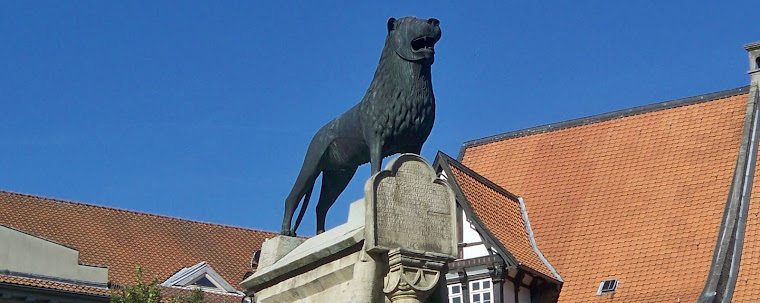

This statue of a lion was cast in 1166 and erected by Henry the Lion as a symbol of his power and jurisdiction. This statue was the first free-standing monument of the middle ages. The legend goes, that Henry brought a real lion back with him to the city during the crusades and kept it in this square.

If you look closely, you can see the claw-marks in this wall of the cathedral where the lion tried to escape.

The collegiate Church of St. Blasius, which is presently a Protestant Lutheran cathedral, was erected by Henry the Lion during the years 1173-1195 after his return from the Holy Land. He built is as his place of burial.

Henry built this castle as his place of residence.

He also had a passage built from his castle to the cathedral, so that he could enter the holier front of the church directly rather than entering from the less holy back of the church.

The back of the castle (Burg).
A digression: there are two different words for castle in German: die Burg and der Schloss. A Burg usually refers to a smaller residence and is better translates as a fortified castle while a Schloss refers to a more elaborate palace.

No comments:
Post a Comment