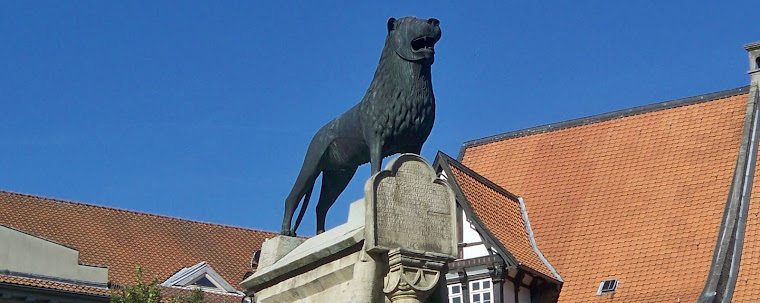

The foundation and building of the Braunschweig Cathedral dates back to the 1100s. It was built as a three-aisle pier basilica with west construction. The transept and crypt were dedicate to St. Blasius, St John the Baptist, and Thomas of Canterbury. Construction work on the cathedral began after Henry the Lion returned from a pilgrimage to the Holy Land, bringing back with him relics which he then donated to various churches including this one. He wanted the cathedral to be a "worthy resting place for himself and his family".
 |
| inside the cathedral |

Yes, you guessed it, seven is an important Biblical number (7 days of creation, 7 sacraments, 7 archangels . . .) and this shapes also follows the 7 armed candelabrum in the Temple of Solomon, also known as the menorah.
When Hitler rose to power and the Nazis came to Braunschweig, they saw this and immediately wanted to destroy it, because it echoes a Jewish menorah. But when Hitler found out that Henry the Lion (historical German hero) commissioned it, he changed his mind.

This picture really doesn't do them justice, but the front part of the cathedral is covered in beautiful frescoes, the most impressive of which (below) depicts the new city of Jerusalem to be established at the second coming of Christ.

The most important piece of art the church houses is the Imervard Cross.

It is a "Volto Santo" cross, which means "holy face."
What is different here is that Christ wears a long-sleeved garment that reaches down to his ankles. He is depicted as alive and with his eyes open, not the suffering Christ depicted later in the Gothic period. He is the victor over and the conqueror of death.
The Cathedral also houses many royal graves, some of which are located in the "under-church" and others in the crypt.
 |
| the "under-church" |
 |
| the crypt |
 |
| (note: i did not take this picture) |
The tomb of Henry the Lion and his wife Mathilda is located near the alter of the church. It is also an important piece of art, because for the first time in history, a man and his wife were laid side by side. Funny story: when the Nazis assumed power, they opened the tomb hoping to discover a symbol for their ideology of a superior race, but discovered a short man with black hair. Thinking this must have been a mistake, they exhumed other bodies from the royal crypt, selected one they deemed, the "real" Henry the Lion and switched the bodies. After the war, historians had to come back to the church and fix their mistake!

No comments:
Post a Comment